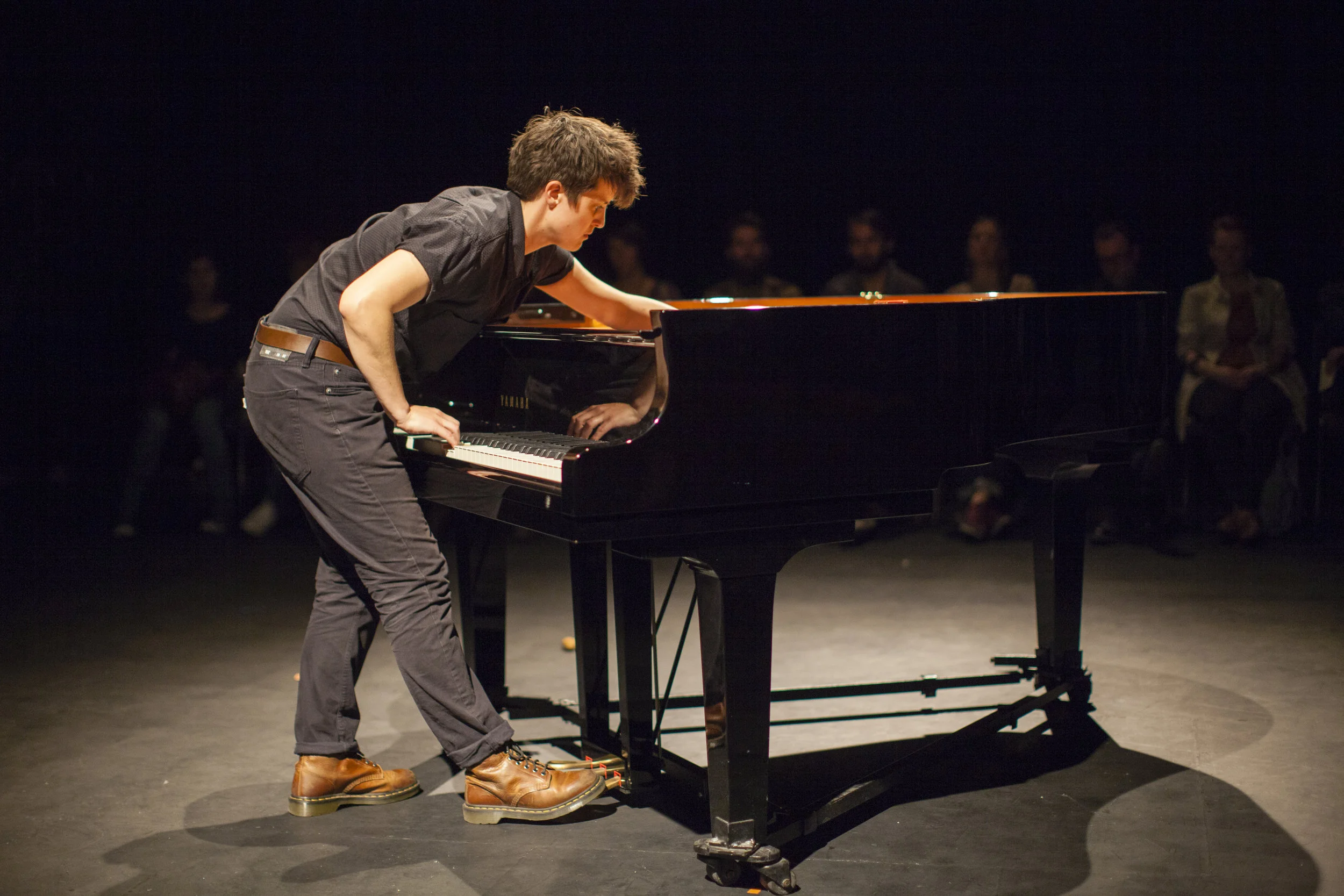
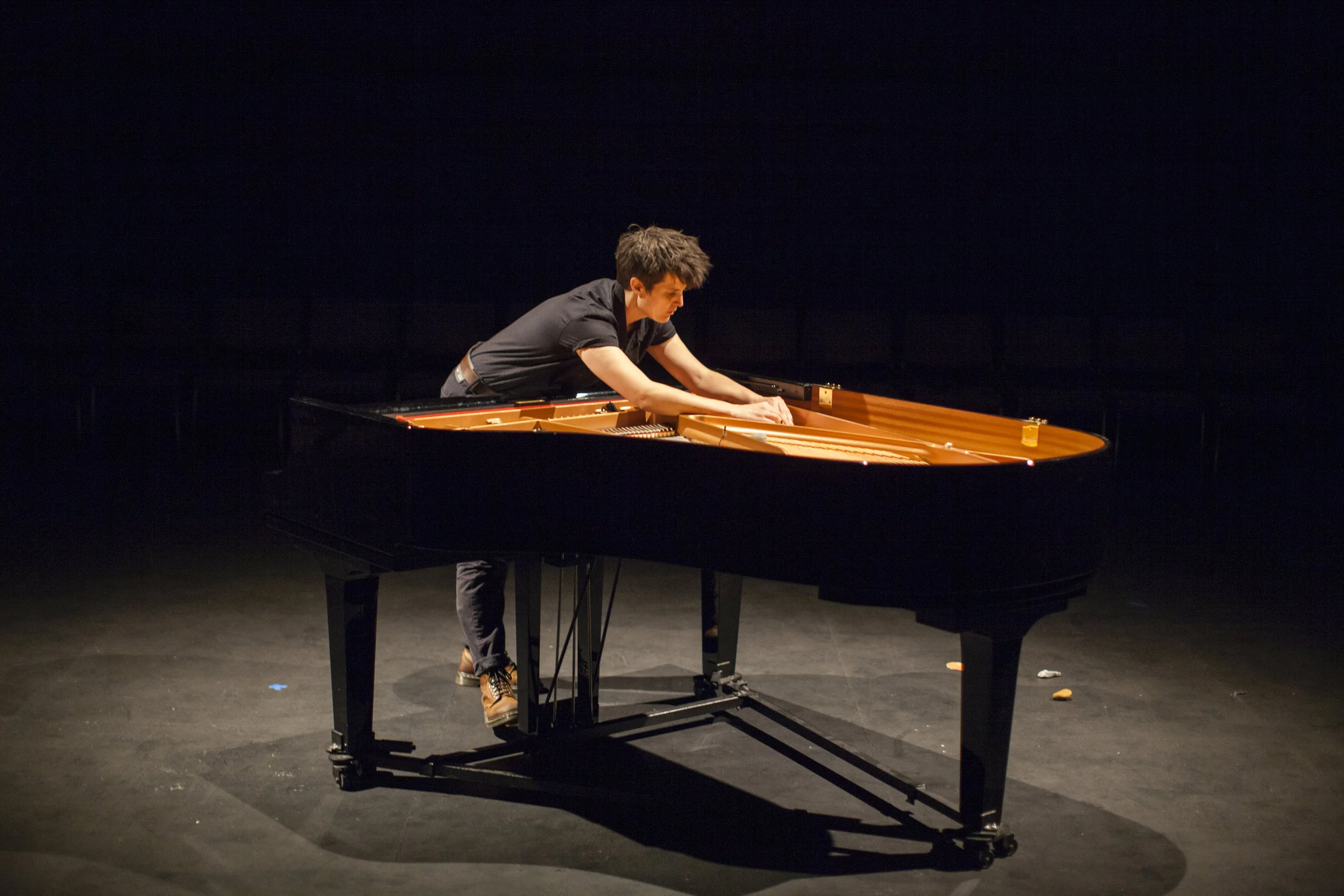
Coastlines Performance, (#three)

Photography from the performance on May 31st, 2019 at the Milton Court Studio Theatre in London, U.K.
All photographs taken by Tom Medwell.


Coastlines Project, (#two)
These sounds have also taught me to take my time. To enter into a deeper listening space. And because this sound world these materials create is unfamiliar and perhaps uncomfortable in a way, it takes a little more time to enter into them. In contrast with a four-to-the-floor 120 BPM track with a groovy baseline — we know what this is and immediately can relax. We’ve heard this before and somewhere in our minds, it goes into a category “familiar”. The unstable, harmonics shifting, buzzing, pitch bending sounds these materials create with the piano and my techniques are brand new.
See Coastlines Project (#one), to get some background info/initial sound recordings on the work I’ve been creating for some more context.
As I navigate through learning this new instrument, I still ask myself, how will this become a performance piece of 30 minutes? This post will be more about of my inner dialogue of this point in the process.
The process of this research journey has taught me so much about stripping back. Of asking, what is truly needed? How will my decisions support the heart of what I am asking here?

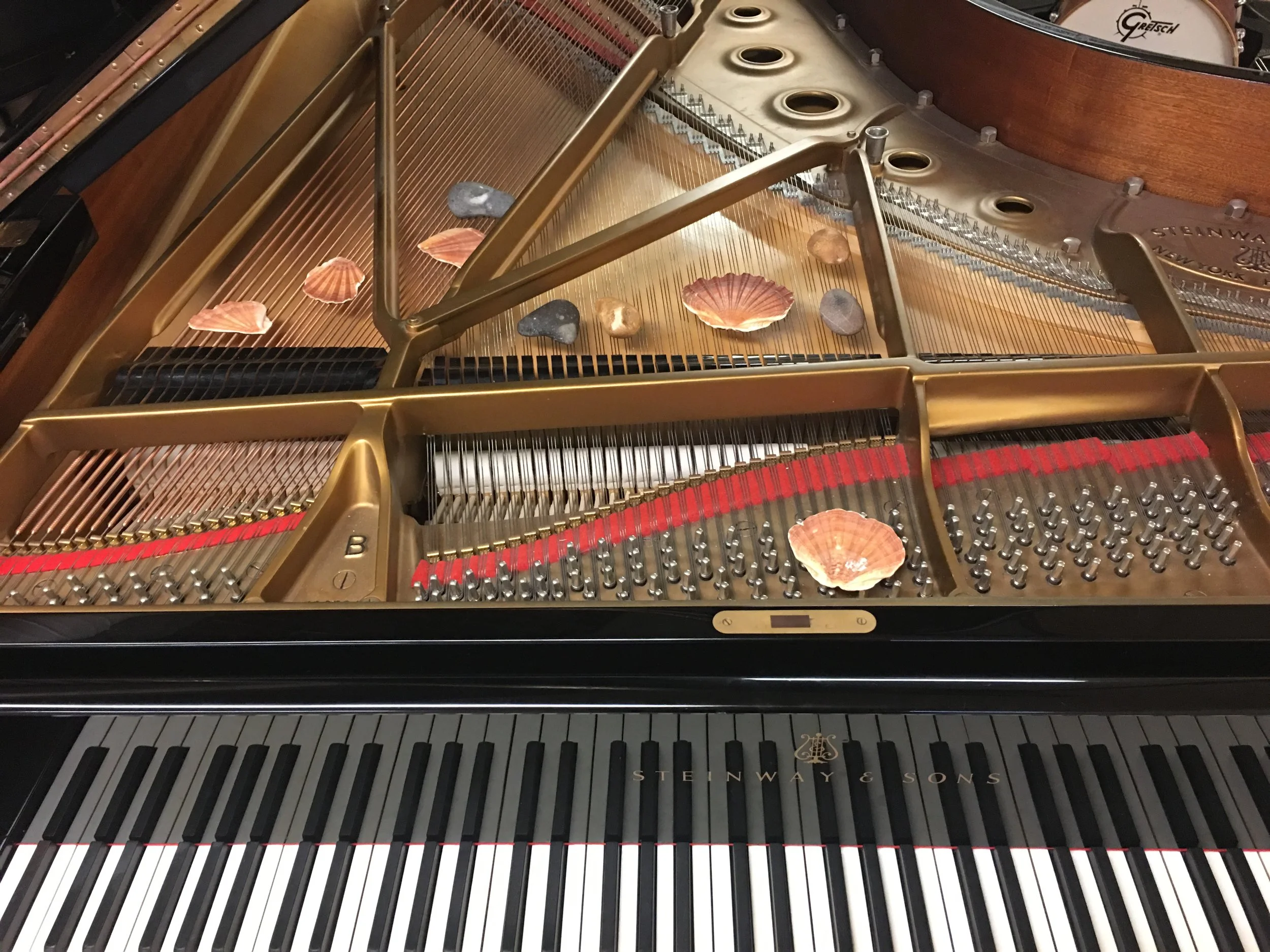
Rocks and shells placed on the strings inside the piano
After a run-through of some of the techniques I had developed, into a thirty minute “performance” for a few of my peers, one question popped out in particular. Am I composing this piece? Am I improvising this? And if it is in-between, how can I be confident in my choices, and at the same time, have a fresh perspective on the material I am producing? It is in the moments of “ah, what was that sound? Let me keep doing that, see what else emerges!”, the unpredictable, sometimes rough around the edges, and indeterminate moments that are actually the ones that stand out the most. Any piece of material that sound at all fabricated in the least, stands out as pre-determined and looses some of that magic of the unpredictable.
These sounds have also taught me to take my time. To enter into a deeper listening space. And because this sound world these materials create is unfamiliar and perhaps uncomfortable in a way, it takes a little more time to enter into them. In contrast with a four-to-the-floor 120 BPM track with a groovy baseline — we know what this is and immediately can relax. We’ve heard this before and somewhere in our minds, it goes into a category “familiar”. The unstable, harmonics shifting, buzzing, pitch bending sounds these materials create with the piano and my techniques are brand new.
So, to simplify once more.
Listen. Take your time. Silence is a space of integration. One sound at a time. There is a world inside of the simplest of sounds. Allow it to be.
Coastlines Project, (#one)

In about three weeks, I will be presenting work that has been part of a year long enquiry process as part of my Masters course at the Guildhall School. Instead of only showing the final and finished product at the very end, I’ll give weekly installments of how it’s going and what I am discovering.

In essence, my research investigates the in-between and live edge, through emergent relationships between myself, materials from coastlines, and prepared piano. I went from having plans to work with live processing and two instrumentalists, to realizing the acoustic sound of the materials is enough. Now it is a trio of myself, the materials and the piano. This choice felt risky and exposing at first, but later became a liberating one which continues to reveal a deeper trust in the enquiry itself. Less is more, and this research has surely challenged me to strip back to reveal the essence of what is needed.

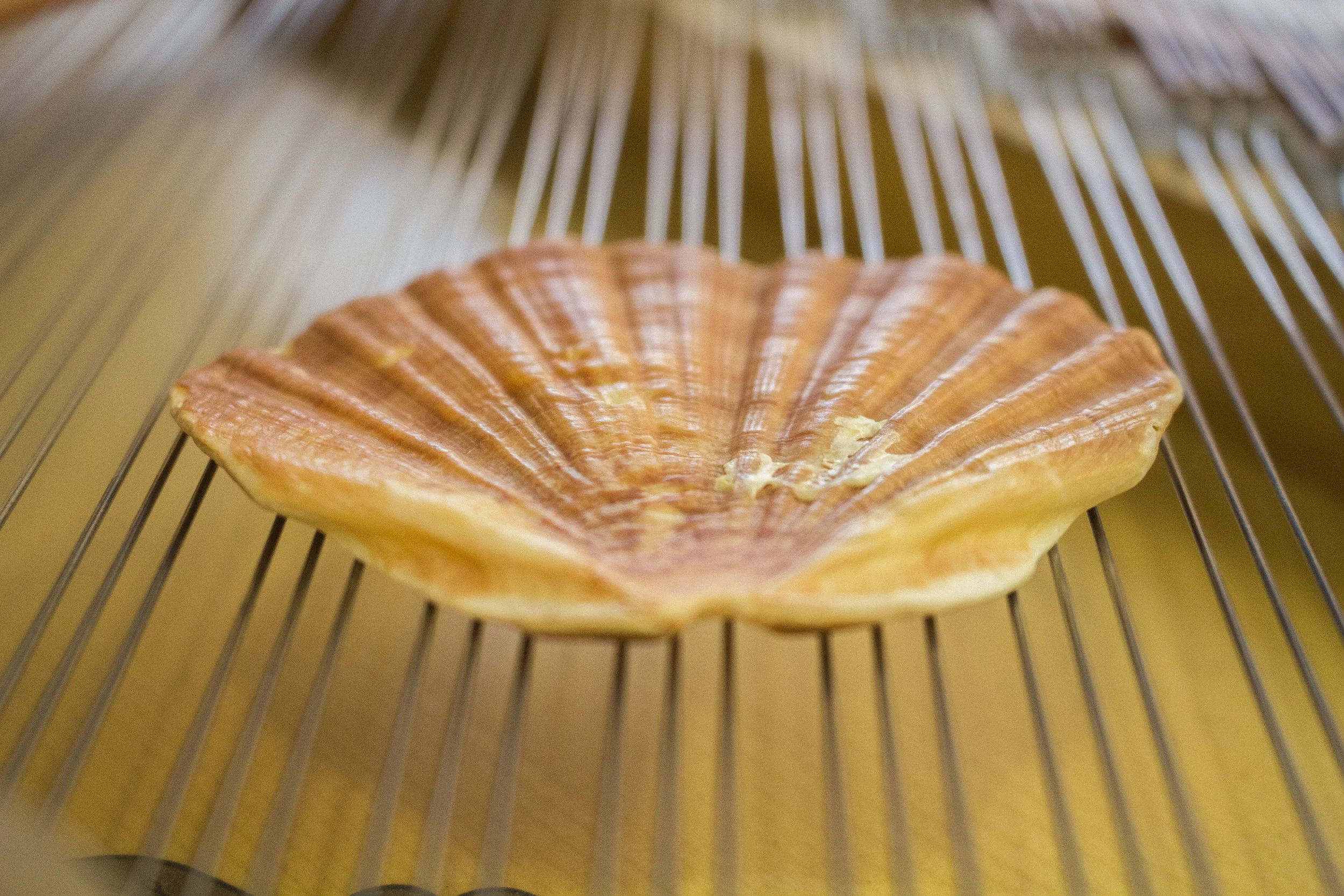
The materials I am using consist of rocks and shells found in coastlines. These thresholds of land and sea are immeasurable to an exact degree, and because they are in constant flux, the nature of how and where these materials are formed are significant aspects to consider in my enquiry. This juxtaposed with a piano, human made and designed to specific detail, shows how the in-between continues to find new connections and meaning within my work.

If you’d like to geek out a bit more like I did on the impossible task of measuring coastlines, I’d recommend reading a bit on the Coastline Paradox. See here an article well put for those of us who are inquiring minds and not theoretical mathematicians studying fractal geometry.