Future Band, conductive paint and new instruments
Future band. New sounds, new instruments and cross-generational collaboration.
This past February 2019 over the school half-term, I had the honor to work with a group of creative young humans aged 7-14 in a project called Future Band for the course of three full days. We got to get our hands into some conductive paint, and made never before heard instruments.
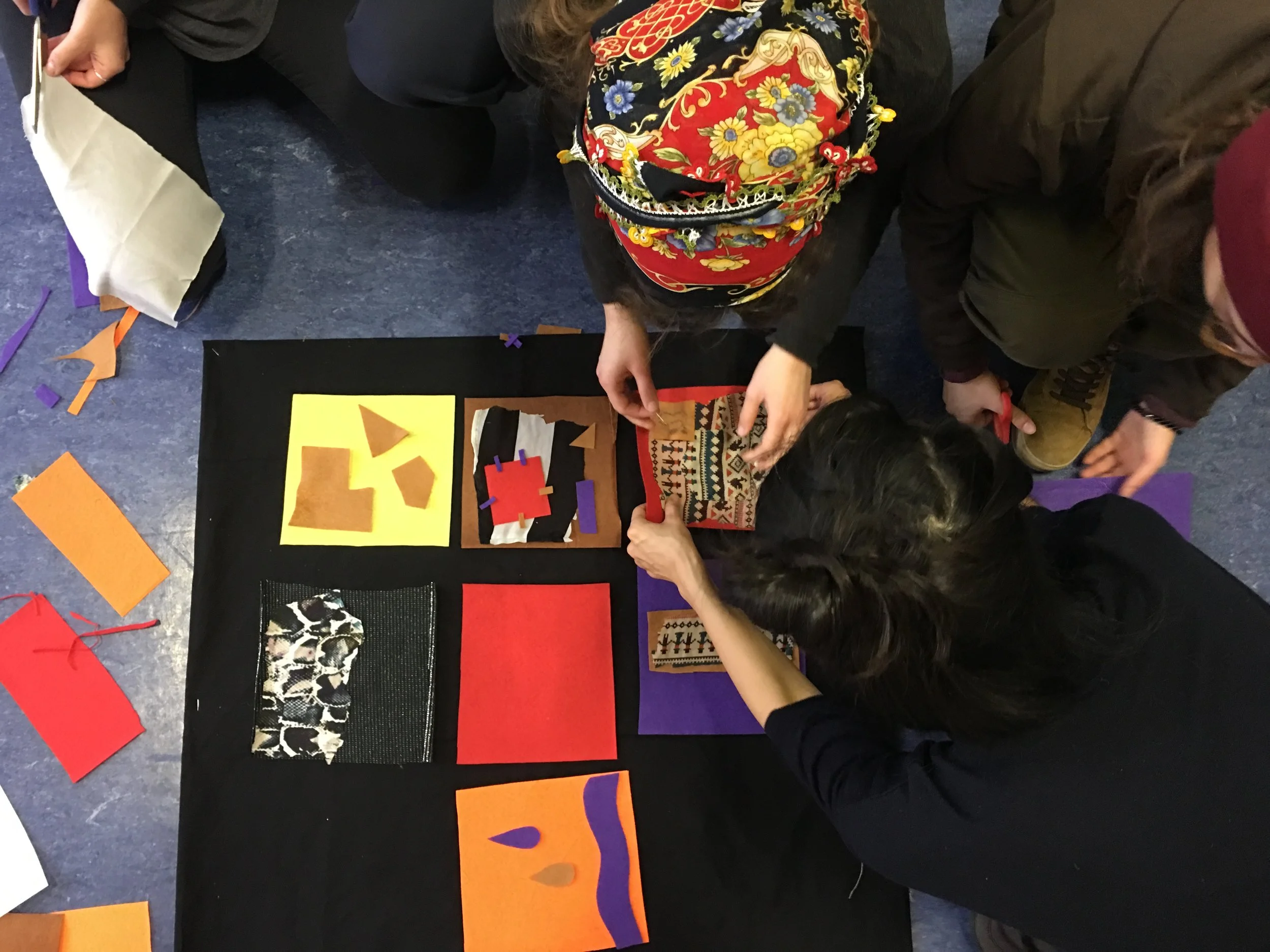
Creating the Comforting Sounds Blanket. A community effort. Felt and conductive threads.
This past February 2019 over the school half-term, I had the honor to work with a group of creative young humans aged 7-14 in a project called Future Band for the course of three full days. Run by two of my beloved tutors on the Leadership Course, Detta Danford and Tash Zielazinski, I took part as a member of the band first and foremost, and also as a leader of small breakout groups and helper to hold the space.
The Future Band “is a performing, composing ensemble where every member is involved in the process of making and playing the music we create. For us composing is being in a room and having ideas, listening, responding, building and unbuilding. It is collaborative and involves working together through playing, improvising, listening, discussing, editing, structuring and rehearsing.” In this edition of the band, we had a special guest which certainly had me feeling like a 10 year old, eyes open and hands ready to make. Lia Mice, our guest, came in with arms full of cardboard boxes, old CD’s, cassettes, colorful papers, wires, felt sheets, and *drumroll please*….conductive paint! The magic ingredient which could turn just about anything you can paint into an instrument. Let’s see how below.
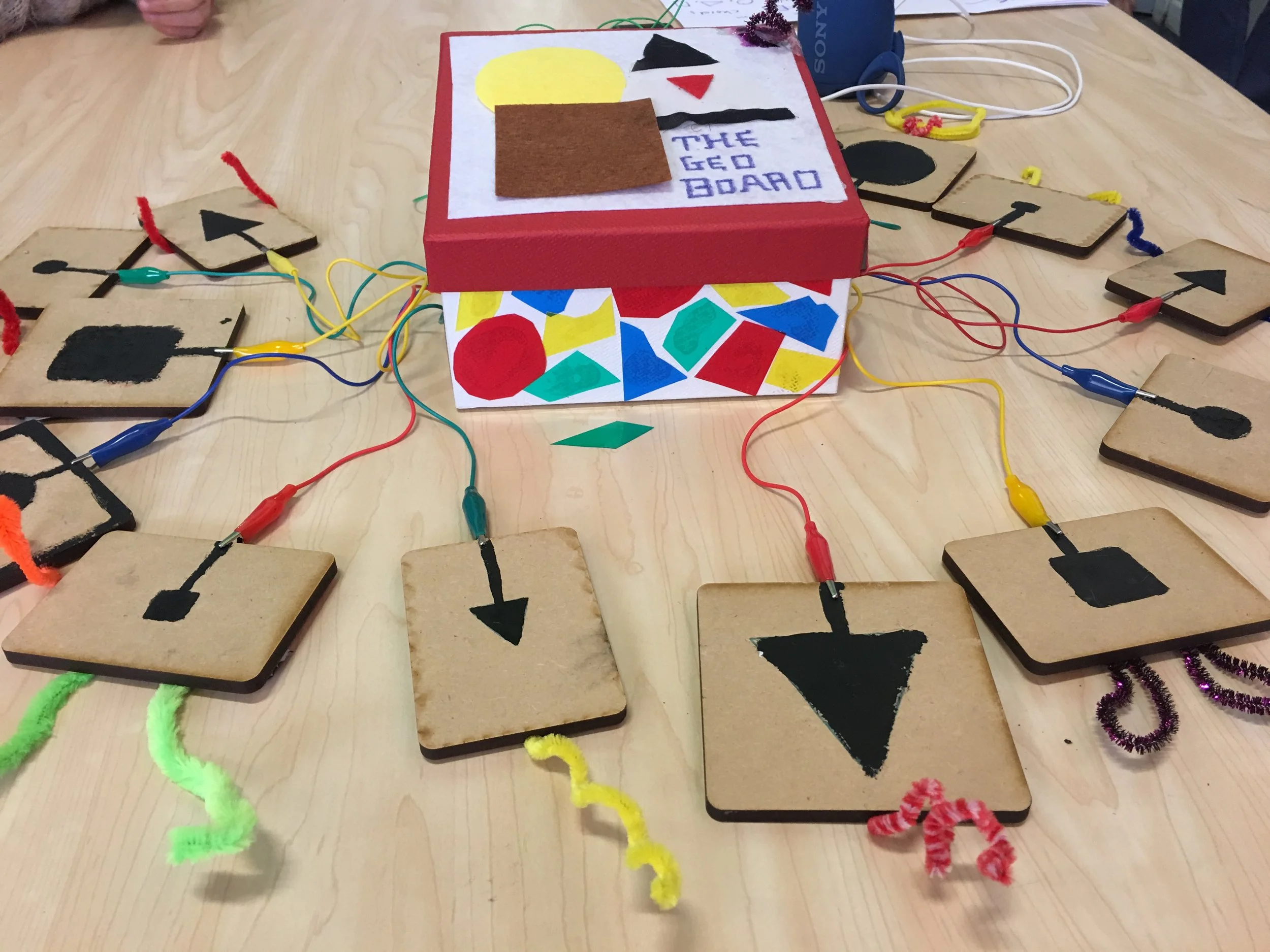
The Geo Board.
Conductive paint contains carbon, which makes it conductive to receiving a signal such as touch. When hooked up to a software like Ableton, you can add samples of the sounds you want it to play when the paint is touched. See an example from the Bare Collective below on how conductive paint can work in action.
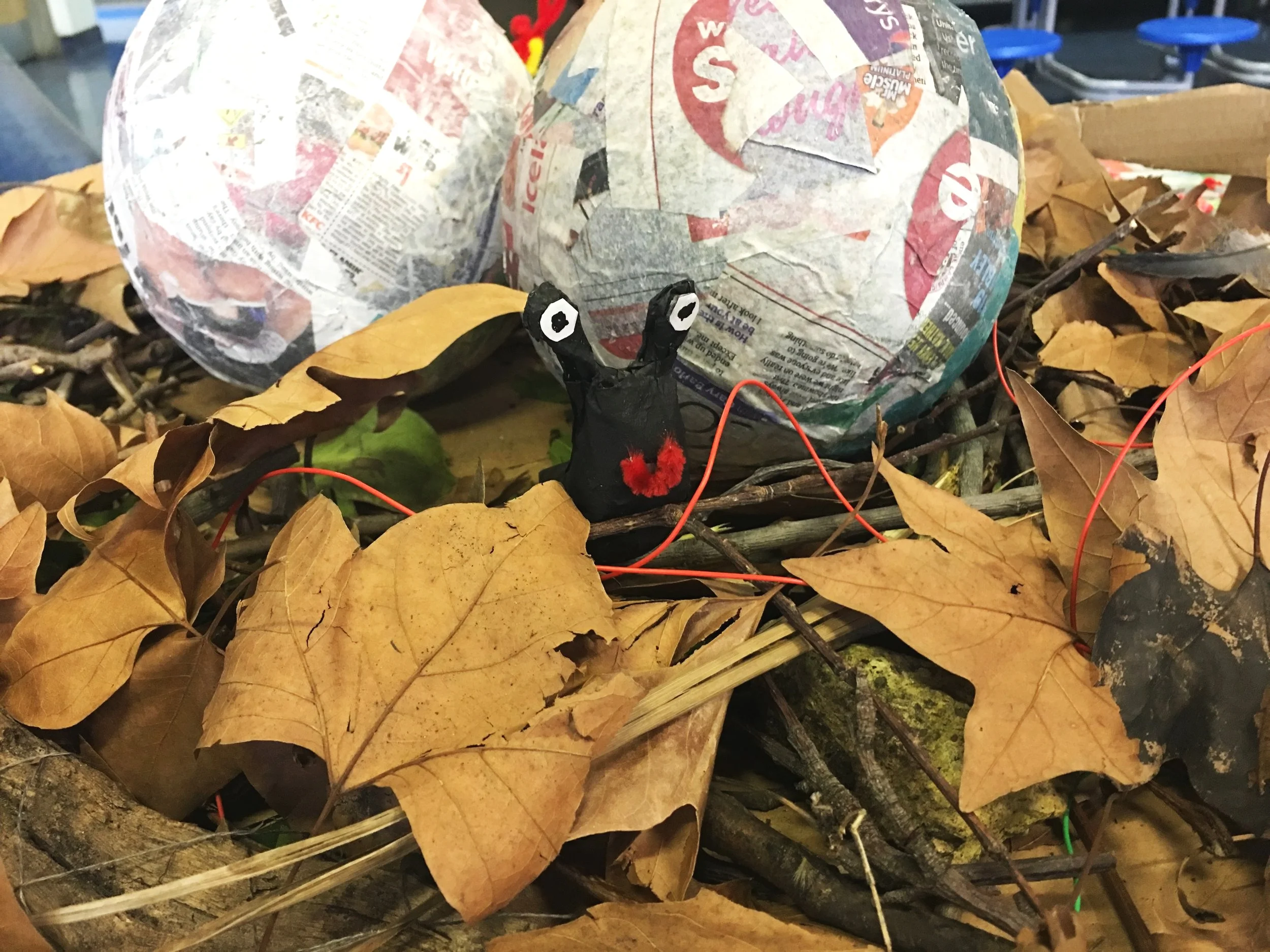
We spent the first day of the three day project dreaming up instruments and came out with a wide array of different visions and sounds… One was a nest, called Sunny Side Up comprised of leaves, sticks and stones found outside and paper maché eggs and slug. This was the group I worked with for most of my time, recording sounds and putting into Ableton. We made a variety of sound on our instruments, as though we were birds. There was also a comforting sounds blanket, seen at the top of this post, with different pieces from the group captured into conductive fabrics and thread.
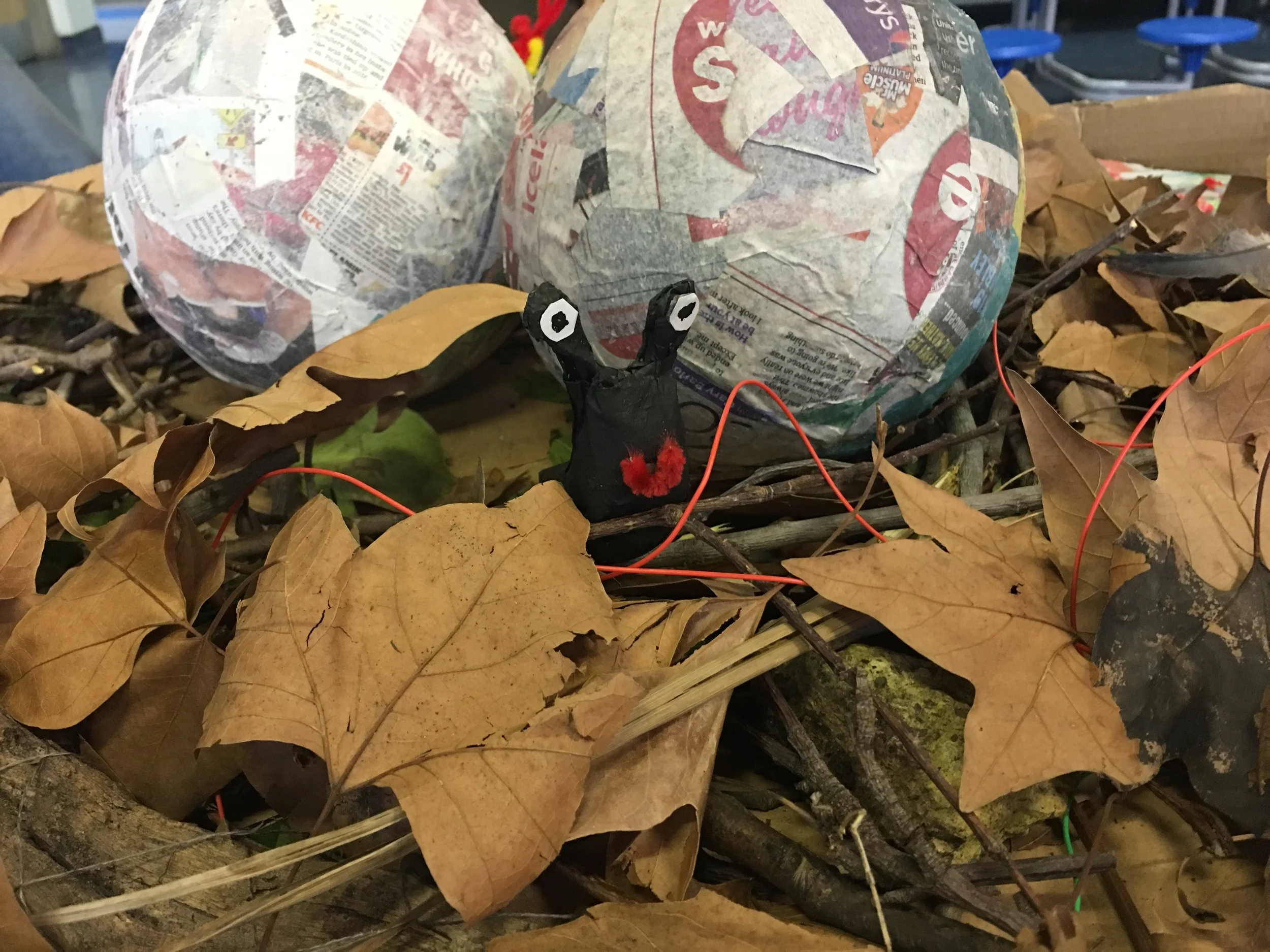
Sunny Side Up
Another instrument, called the Pianophone, which was arranged like one chromatic scale of a piano. Behind each key though, was a different arrangement of instruments playing each note.

Beatriz in action working on the Pianophone
What left me most inspired about this, was that anyone can get inspired anytime and anywhere. I have learned so much working with these young people. When possibilities are endless, when sounds don’t have to be “perfect” by western classical standards, when there is the space to explore your instrument in a new way away from scales and traditional technique. When everyone’s ideas are welcome and encouraged. When there are no wrong answers. Put all of that into a creative, democratic, musical, generative space, and it’s amazing what can happen in three days. We finished with newly built instruments, and a thirty minute performance for the parents and families of the kids. I try to imagine what it would have been like to have had this experience when I was at their age, and I think it must have been all-around-awesome. Why? Well, mostly because as a nearly 27 year old, it was certainly all-around-awesome for me too! Give me a paintbrush. Let’s go out and record some sounds and make a sound nest. I’m all in.
Some links to leave you with and to hear some of Future Band’s previous work…
Here is a short film about future band. https://vimeo.com/108892785
To see more work from the Future Band creators and leaders; Detta Danford, https://www.dettadanford.com/, and Natasha Zielazinski https://natashazielazinski.com/.
Check out Lia Mice, who helped make all of this possible. https://www.liamice.com/
If you’d like to find out more about Conductive Paint, look no further than the Bare Collective, where you can find all of your instrument building supplies.
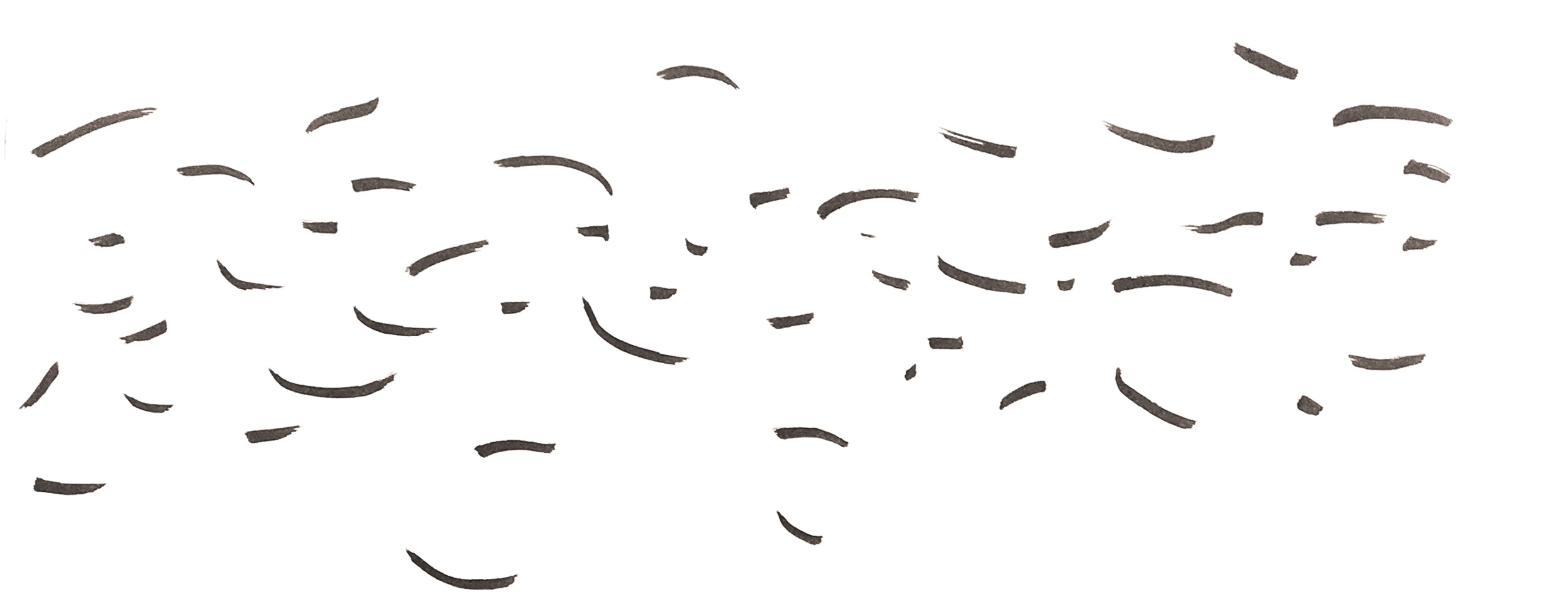
Do Not Be Afraid of Unstable Sounds
I’ve been exploring themes this past year revolving around the concept of the in-between, liminal spaces, thresholds, and live edges. The live edge represents the in-between, a space where we can inhabit. Where edge implies a certain kind of binary, either you are on the edge or you are off, a live edge is a “porous membrane”, a non-binary space we can inhabit, and is a place where we can develop skill.
“Certainties disappear; rhythms buried deep in muscle memory have to undergo a blurring of memory; the note that comes next is no longer fixed” (David Toop, Into the Maelstrom p 16)
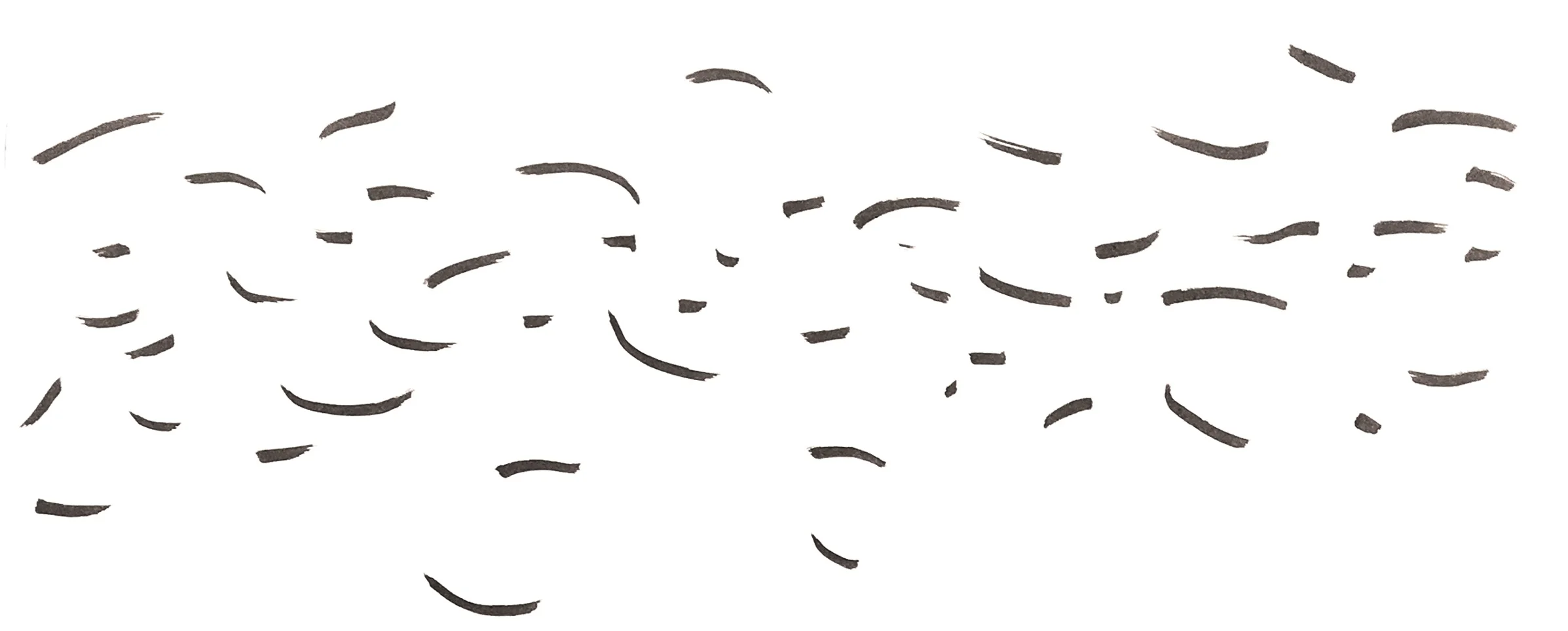
Recently, our Guildhall MMus Leadership team of artists had a residency week at Iklektik in London, March 13th-18th. This was part of the Freedom of Movement Festival curated by Jan Hendrickse and Nell Catchpole, which focused on the medium of sound and it’s “capacity to disrupt, permeate, or circumvent perceived boundaries and norms.”
I’ve been exploring themes this past year revolving around the concept of the in-between, liminal spaces, thresholds, and live edges. The live edge represents the in-between, a space where we can inhabit. Where edge implies a certain kind of binary, either you are on the edge or you are off, a live edge is a “porous membrane”, a non-binary space we can inhabit, and is a place where we can develop skill (Sennett, p 229).
I have been enquiring into how creative resistance can act as a tool and an entry point into a live edge. A tool that doesn’t obstruct performance, but one that “takes hold of that potential obstruction and puts it to use”. To adopt this kind of attitude that resistance can be a cooperation with one’s materials, “a distrust of the self-evident” and a “technique of investigation” (Callis et al). This kind of attitude toward discovery is one that aligns itself with the in-between and a state of palpable potentialities. Practicing creative resistance is also a kind of political response which does not take things as they are, but allows for what is in front of us to speak with us in new ways. Perhaps also in ways we didn’t realize were possible or could have imagined. To emerge with new ways of creating and becoming in sound through various types of relationship.
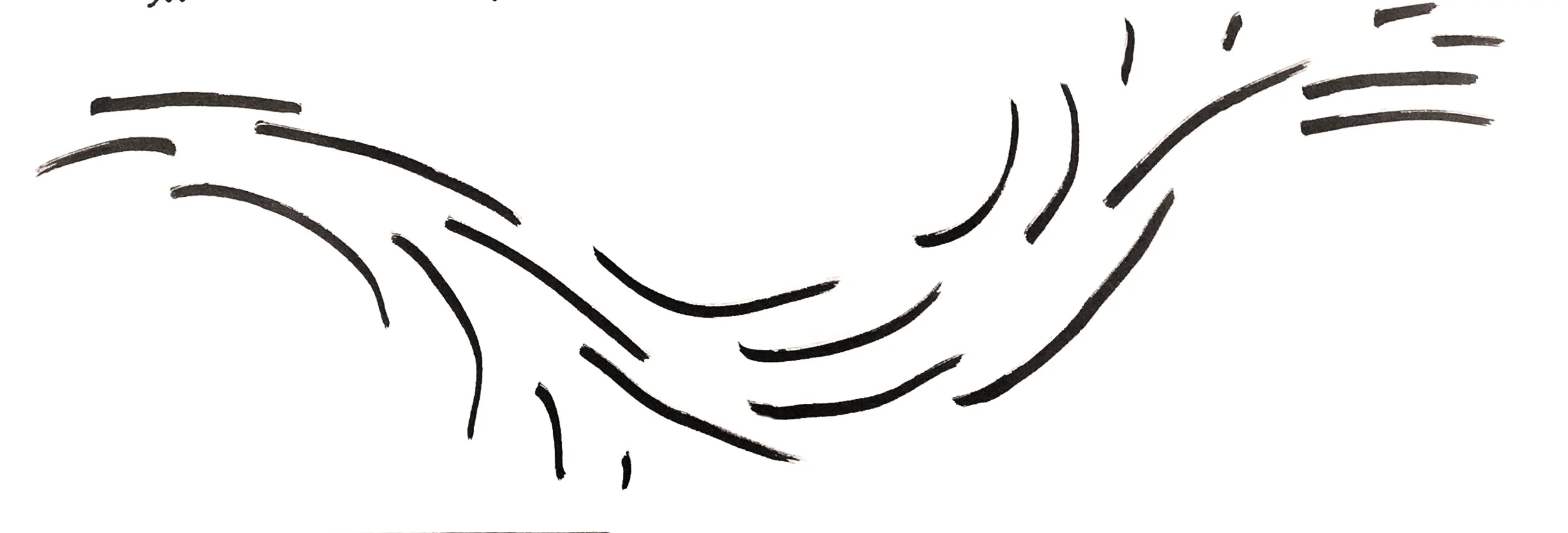
For this residency week, I felt compelled to explore the relationship of composer, performer and indeterminacy in creating a graphic score. In the process of creating, I was very specific about what the graphic score meant to me and the concepts from which it emerged. I thought about live edge and thresholds of control, and the indeterminacy of when my pen would or wouldn’t be making contact with the paper. I thought about how creating accidental ink contact with the paper would result in something very beautiful yet unexpected.

Edges Of graphic/text score, created for Freedom of Movement Festival
I’ve been inspired by the work of John Cage, and his practice of exploring indeterminacy in composition. In a compositional process, when elements of a score are left up to chance or choice, or are not intentionally specified, the nature of the performance is left indeterminate (Cage). This allows the score and the performance to be what it will be.
In creating the score, there were aspects that felt specific (or, determinate), and aspects that I wanted to leave open (indeterminate). For example, I wanted the score to be performed by an instrument which could sustain a note -- such as a bowed instrument or a flute. I wanted to inspire the performer into thinking about the in-between and creative resistance, but without explicitly saying it. I used the language “you may want to consider…” to imply an option but ultimately left it up to the performer’s choice. “Don’t be afraid of unstable sounds” was slightly more pointed toward my enquiry, but still left open to be explored and left the graphic score to speak for itself to each individual performer.
I was more interested in the process the performer would choose to take in the interpretation and exploration with this score. Such as what would emerge out of their relationship with their instrument, and what would inspire them visually about the score to create a sonic performance.
Do you read one line at a time? Does one line imply one ‘note’ or not? Do you repeat a line several times? How literally do you take the suggestion of using pressure?
One example of indeterminacy resonated with me was first hearing Bennett Hogg’s piece Devil's Water 1, where he used the current of a river to “bow” the strings of a violin as the stream passes through the violin’s body. He found himself “chasing a particular sound, even though that sound was not actually there but was being made through the interaction of the river, the violin” and himself (Hogg). This collaboration of materials blurs the role of composer, performer and material. There are certain elements that he could have artistic control over, like the tuning of the strings and the positioning in the river, but how the water would “bow” the strings would ultimately be indeterminate. I would consider this a live edge intra-action of creativity, composing and improvising between the materials, the person and their gestures, the river, the microphones and the violin.
References.
Cage, John. Silence: Lectures and Writings. Wesleyan University Press, 1961.
Callis, Sarah, et al. “Creative Resistance as a Performance Tool.” Music and Practice, vol. 2,
www.musicandpractice.org/volume-2/creative-resistance-as-a-performance-tool/.
Hogg, Bennett. “The Violin, The River, and Me: Artistic Research and Environmental
Epistemology in Balancing String and Devil's Water 1, Two Recent Environmental Sound Art Projects.”
Hz Journal, vol. 18, May 2013, www.hz-journal.org/n18/hogg.html.
Sennett, Richard. The Craftsman. Yale University Press, 2008.
Toop, David. Into the Maelstrom: Music, Improvisation and the Dream of Freedom. Bloomsbury
Publishing Inc, 2016.